
Power users often assume that a wallet’s job is merely to hold keys and broadcast signed transactions. That assumption is the hidden vulnerability: blind signing—approving a transaction without knowing its exact effects—remains a root cause of many DeFi losses. Transaction simulation reframes the problem: before your signature is released to a smart contract, your client can run the same steps locally against a replicated state and report the exact balance and approval changes you should expect. In practice this reduces cognitive load, surfaces hidden fees and slippage, and translates contract opcodes into final token deltas you can judge.
This article walks through the mechanics of transaction simulation for DeFi power users, uses Rabby’s browser extension as a real-world case, and clarifies where simulations help, where they can mislead, and what governance or operational choices still fall on the user. My aim is practical: give you a mental model for when a simulation should change behavior, and the checks to apply when it doesn’t match expectations.
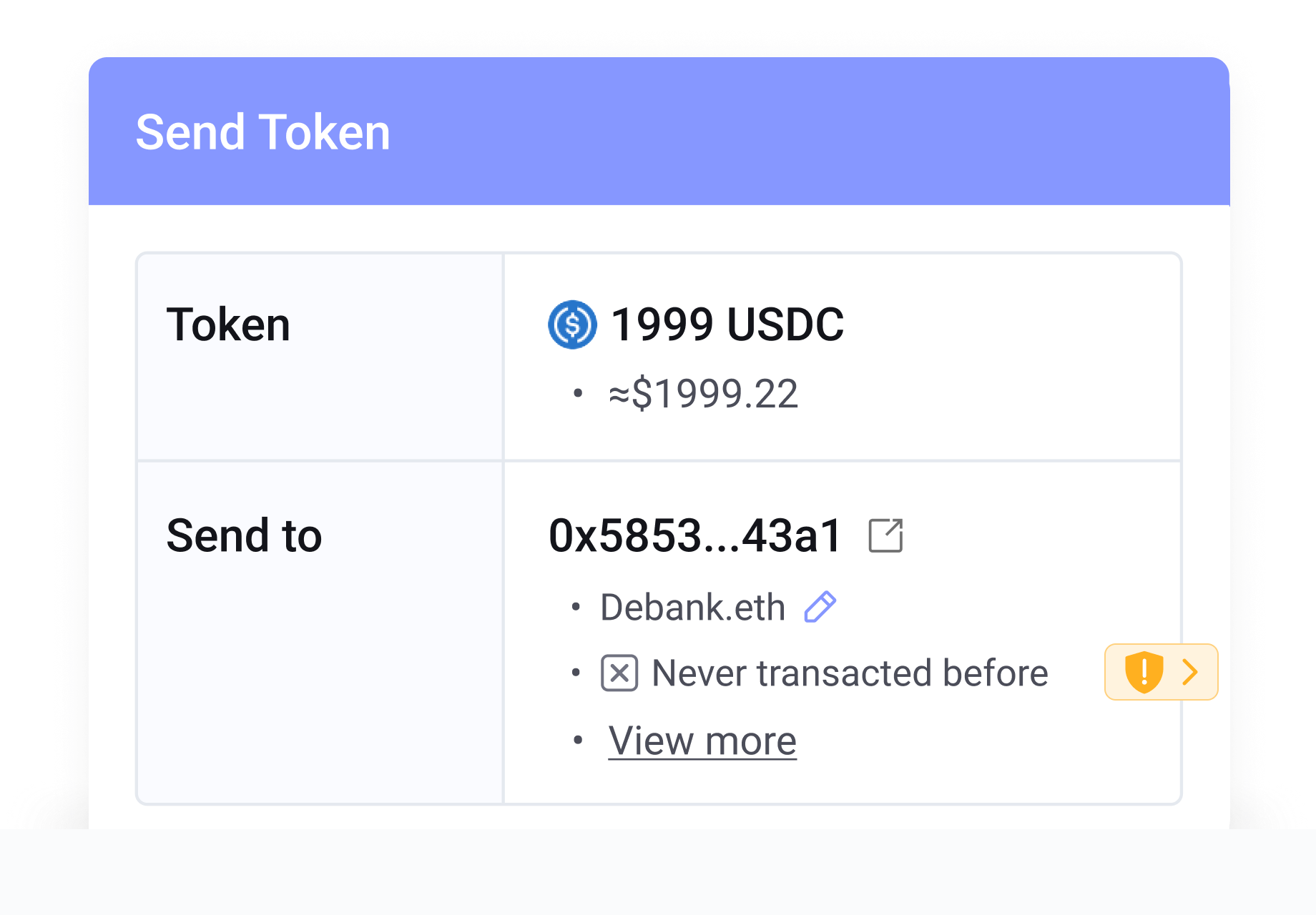
How transaction simulation works — mechanism first
At its core, simulation is deterministic replay. The wallet builds the exact call (to a token contract, a router, or a custom smart contract), assembles contextual inputs (sender, gas price, calldata, nonce), and executes that call against a snapshot of the blockchain state using a local EVM implementation or a remote node that supports eth_call. The result is not a promise of what will happen on-chain — it is a forensic projection of the state transition given the inputs and the state you simulated against.
Key outputs typically include: estimated gas used, fee cost in native token, token balance deltas (how many tokens leave and arrive in each relevant address), and any emitted events or revert messages. Advanced simulations also model post-execution allowances (approval changes), approvals implicitly created by some contracts, and whether the call would revert against current contract code. Rabby’s simulation layer displays “exact estimated token balance changes and fee costs” to prevent blind signing: that mapping from calldata to token-level effects is the decision-useful abstraction for most DeFi users.
Why simulations matter for a DeFi power user
Simulations compact a large, technical surface area into three practical decisions: is this trade the token swap I expect; is the approval or allowance change acceptable; and do the fees and slippage match my tolerance? For example, an apparently routine “swap USDC→DAI” might include an intermediate bridge or wrapper that temporarily mints or burns tokens, or a router that drains liquidity and creates an unexpectedly large slippage. Seeing token deltas before signing turns those subtleties into a yes/no judgment rather than a blind hope.
For institutional and multi-sig setups, simulation is even more valuable. Teams often gate on pre-approval checks. Rabby’s integrations with multi-signature and enterprise tools like Gnosis Safe and Fireblocks mean simulations can be part of an approval workflow: the approver sees the precise expected state changes and can veto based on policy. This is a classic risk-reducing step, not a panacea; it reduces human error but cannot immunize against contract-level exploits or post-signature race conditions.
Rabby’s browser extension: what it adds and what it doesn’t
Rabby’s browser wallet (available as a Chromium extension) implements simulation with several adjacent features that make the outputs usable. First, automatic network switching reduces friction—Rabby detects which chain a dApp requires and simulates in the correct environment rather than relying on the wrong network state. Second, its pre-transaction risk scanning flags known-bad contracts, suspicious approval requests, or non-existent recipients before you even look at the simulation. Third, the wallet exposes an approval revocation UI so that when a simulation reveals an excessive allowance you can revoke it without leaving the extension.
These are valuable combinations: simulation without revocation is informative but harder to act on; revocation without simulation is reactive rather than preventative. Rabby bundles both behaviors and layers on portfolio tracking and cross-chain gas top-up utilities, which matter in multi-chain workflows because running a simulation is only useful if you can actually execute the validated transaction on the intended chain.
Important practical limits remain. Simulations are run against a snapshot; the real chain state can change between simulation and broadcast (nonce increments, MEV sandwiching, front-running, or reorgs). Simulations do not (and cannot) predict off-chain oracle updates, fee-market volatility, or complex governance outcomes triggered by transactions interacting with many contracts over time. Also, Rabby currently lacks native fiat on-ramps and in-wallet staking, so simulation does not replace the need to manage liquidity entry and reward flows externally.
Where simulations succeed, and where they break
Success cases are straightforward: single-call token swaps, approval changes, and simple liquidity operations. If you are changing allowances, swapping on a standard AMM router, or executing a single-contract call, simulation will generally show the token deltas you should expect and the fee cost you will pay. For these, simulation materially reduces accidental losses and makes approvals auditable.
Failure modes fall into categories. Time-sensitive state changes (oracle-dependent trades) can flip outcomes between simulation and execution. Batch transactions that rely on off-chain events or on-chain randomness (oracles, blockhash-based functions) cannot be reliably forecast. Multi-contract flows and meta-transactions can hide intermediate steps that a simplistic simulator may not reveal unless it executes the full call tree with accurate state. Finally, simulation depends on the fidelity of the execution environment: differences in node configuration, EVM versions, or subtle bugs can yield false negatives or false positives.
A practical decision framework for power users
When deciding whether to sign, I recommend a three-step heuristic:
- Match intent: Compare the simulation’s token deltas and fee estimate to your intended outcome. If token flows include unexpected addresses or approvals exceed policy thresholds, pause.
- Check state-sensitivity: If the transaction reads or depends on oracles, liquidity that changes rapidly, or if it executes across multiple bridges, treat the simulation as a lower-confidence signal and tighten slippage or use smaller test amounts.
- Mitigate execution risk: For high-value operations, fragment the action into a low-value proof transaction first (a dry-run swap of a tiny amount) or require multi-sig confirmation after simulation to add human review time against front-running risks.
These steps map well to Rabby’s feature set: automatic network switching makes “Match intent” simpler, pre-transaction risk scanning improves the signal for “Check state-sensitivity,” and integration with multi-sig tools supports “Mitigate execution risk.”
Trade-offs: security, UX, and performance
Adding simulation imposes costs. Accurate simulation requires either a local EVM engine or a reliable RPC provider; both add complexity and latency. Power users trade instant signing speed for a richer pre-sign view. Moreover, displaying too much raw technical detail creates cognitive overload; wallets must choose which abstractions to present. Rabby’s design favors token-level deltas and explicit fee estimates — a pragmatic compromise for DeFi users who want clarity without drowning in ABI-level logs.
Open-source architecture is a further trade-off. It improves auditability (third-party security researchers can inspect code) but raises operational visibility that sophisticated attackers might use to find implementation quirks. Transparent security and rapid patching are positive, but only when development processes and response plans are strong — which Rabby demonstrated in its past incident response where a exploited swap contract was frozen and users were compensated. That episode is instructive: simulations and post-facto fixes helped, but vulnerability remained because no single layer eliminates risk.
What to watch next — conditional scenarios
Three conditional developments would increase the effectiveness of transaction simulation in practice. First, wider adoption of standardized simulation APIs from major RPC providers (with verifiable snapshot capabilities) would reduce environment mismatch and improve confidence. Second, richer metadata standards for approvals and allowances (so wallets can map approvals to business-level purposes) would let simulation results be interpreted automatically by policy engines. Third, combining simulation with time-locked signing or threshold-based signing for high-value transactions would materially reduce frontrunning and MEV risk — but this requires multi-party coordination and UX work.
Any of these are plausible but not guaranteed. Monitor network-level tooling (RPC snapshot promises), wallet UX updates, and multi-sig adoption in US institutional contexts. If regulators increase expectations for pre-transaction risk disclosures or subject certain custodians to audits, wallets that provide explicit, auditable simulation trails will be at an advantage — though that also raises compliance and data-retention trade-offs.
Where Rabby fits in the wallet landscape
Rabby positions itself as a security-first, multi-chain alternative to mainstream wallets by combining simulation, approval management, and automatic network switching. For US-based DeFi power users, that combination is decision-useful: it reduces the typical sources of human error in high-frequency or high-value DeFi activity. It is not a complete operational security solution — hardware wallet integration, careful key management, and institutional controls remain necessary. That said, Rabby’s open-source codebase, cross-chain gas top-up, and integrations with hardware and institutional providers make it a practical choice for users who want simulation without sacrificing multi-chain flexibility.
If you want to try the browser experience and see how simulations look in situ, the rabby wallet extension exposes these features in a Chromium extension form factor and supports hardware wallets and multi-sig workflows.
FAQ
Q: Does simulation guarantee my transaction will succeed?
A: No. Simulation guarantees only that, against the snapshot and execution environment used, the transaction would produce the shown effects. It cannot guarantee real-time network conditions, oracle updates, or front-running will not change outcomes between simulation and broadcast. Treat simulation as a high-quality prediction for deterministic parts of the call and a lower-confidence indicator for stateful or time-sensitive logic.
Q: Can simulation detect fraudulent or malicious contracts?
A: Simulation can reveal suspicious behavior like hidden token drains or unexpected allowance changes, but it cannot fully detect subtle on-chain logic that behaves maliciously only under certain conditions or when combined with off-chain incentives. Rabby’s pre-transaction risk scanning adds another layer by flagging known-bad contracts, but neither measure replaces code audits or formal verification for high-risk deployments.
Q: If I use a hardware wallet with Rabby, does simulation still work?
A: Yes. Rabby integrates with hardware wallets and will run the simulation in the extension before you confirm on-device. The hardware device still signs the final transaction; simulation does not expose private keys. This preserves a strong security posture while giving you the visibility to make informed signing decisions.
Q: Should I always require multi-sig for large DeFi operations?
A: Multi-sig is a strong control for high-value operations because it inserts human or organizational checks after a simulation but before execution. However, it costs time and complexity. A practical compromise is to require multi-sig above a value threshold and use single-key, simulation-checked flows for routine smaller operations.
0 Comments